Ride types
Audax comes in a handful of formats: shorter events, brevets from 200 to 1,000 km, permanents you ride on a day of your choosing, a team ride at Easter, mountain 600s, and rides of 1,200 km and more over several days. This is what each one asks of you, and which awards it counts towards.
At a glance
- Shorter rides
- 100 to 199 km on the calendar; 7 hours for a 100
- BRM
- 200 to 1,000 km on a set date, recognised worldwide
- Permanent
- An approved route, ridden on a date you choose
- Flèche
- A team of 3 to 5 bikes, 360 km or more in 24 hours at Easter
- SR600
- 600 km with 10,000 m of climbing, or a 600 km BRM with 8,000 m
- LRM
- 1,200 km or more, over several days
- PBP
- 1,220 km in France, every four years
- 100kmA shorter eventOn a set date with other riders, in 7 hours.Find a 100
- 200kmYour first brevetThe standard first Audax, in 13½ hours.Find a 200
- AnydayA permanentAn approved route, on a day you choose.Browse permanents
How every ride works
- The clock never stops. The time limit covers riding, eating, fixing punctures and sleeping.
- Nobody is ranked. Everyone who finishes inside the limit has the same result.
- You find your own way, by GPS or route sheet. Routes aren’t signposted, and nobody follows behind: you carry what you need and buy food along the way.
- Controls are checkpoints on the route. In Ireland you usually prove you were there with a selfie in the ride’s WhatsApp group. Elsewhere it may be a stamp in a brevet card, a receipt or a GPS track.
- Entering an Irish event is through Eventmaster, usually €5 plus a booking fee. You need a Cycling Ireland licence: an annual one, or a €10 one-event licence added when you enter.
The rules page has the detail, and checking your results explains how a finished ride becomes an official result.
Shorter rides
The Irish calendar has 50, 100 and 120 km events, often run from the same start as a 200 on the same day. They are the gentlest way in: a 100 has a 7-hour limit, and the 100s and 120s count towards RRTY 100, a ride a month for twelve months.
- Distance
- 50 to 199 km
- Time limit
- 7 hours for a 100
- When
- On the calendar, on a set date
- Proof
- Photos or answers at controls, as on a brevet
- Counts towards
The tracker labels these rides BP, the name Audax UK uses for its shorter events. In the UK, too, a BP can be as short as 50 km, with minimum speeds of 10 to 12.5 km/h.
BRMs
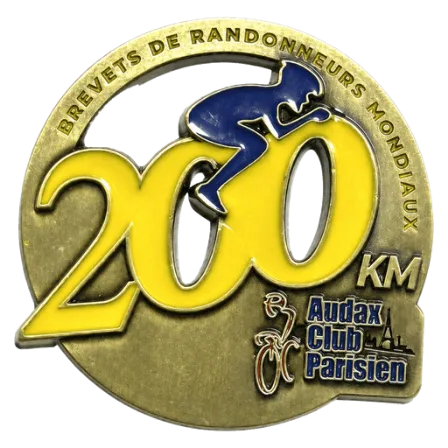
A BRM, or Brevet de Randonneurs Mondiaux, is the standard Audax event: a set route on a set date, recognised by Audax Club Parisien (ACP) so it counts the same all over the world. Clubs run them. In 2026, Audax Ireland and nine other clubs ran events on the Irish calendar.
- Distance
- 200, 300, 400, 600 or 1,000 km
- Time limit
- 13½ to 75 hours
- When
- On the calendar; riders start together
- Proof
- At every control, usually a photo in Ireland
- Counts towards
- 4 Provinces counts Irish calendar events only.
| Distance | Time limit | Overall average |
|---|---|---|
| 200 km | 13½ h | 14.8 km/h |
| 300 km | 20 h | 15.0 km/h |
| 400 km | 27 h | 14.8 km/h |
| 600 km | 40 h | 15.0 km/h |
| 1,000 km | 75 h | 13.3 km/h |
The limit covers everything: riding, food, repairs and sleep. Controls open at 34 to 28 km/h, falling with distance, so nobody can race it.
A 200, 300, 400 and 600 in one season make a Super Randonneur, and that series is what Paris-Brest-Paris asks for. Since 2024, the times at controls along the way are only a guide; the finish time is what counts. You still need proof at every control.
The exact rules
- Controls open at 34 km/h for the first 200 km, then 32, 30 and 28 km/h over longer distances. They close at 15 km/h up to 600 km and 11.428 km/h after that; over the first 60 km, at 20 km/h plus an hour.
- Front and rear lights, one rear light steady, and reflective material front and back. In Ireland, reflective clothing on every ride of 300 km or more, and on a 200 in darkness or bad weather.
- Organisers and helpers may ride the route within 15 days either side of the event, and their ride counts the same.
- ACP’s medals are bronze for a 200, silver-plated for a 300, vermilion for a 400, gold for a 600 and silver for a 1,000. The design changes after each Paris-Brest-Paris.
Permanents
A permanent is an approved route you ride on a date you choose, alone or with a few friends. Audax Ireland keeps the list, from 100 to 600 km, in all four provinces. Send an entry form to the route’s organiser before you ride. It’s free for Audax Ireland members and €5 otherwise, and you need an annual Cycling Ireland licence.
- Distance
- 100 to 600 km
- Time limit
- As for a calendar ride of the same distance
- When
- Any day, arranged with the route’s organiser
- Proof
- Receipts, photos or a GPS track, sent to the organiser
- Counts towards
- Brevet 2000 and 5000 need 200 km or more. For 4 Provinces, one permanent, outside your home province.
You can usually start at any control, and some routes can be ridden either way round. Permanents count for Audax Ireland’s awards, not ACP’s, so they can’t qualify you for Paris-Brest-Paris. The permanents catalogue has every route, and the permanents guide covers entering and riding one.
The exact rules
One exception counts for ACP’s Randonneur 5000 and 10000: an established Flèche de France route ridden in the Gold or Silver division, except Dieppe. It adds distance; it doesn’t fill a required ride.
The Easter Flèche
A team of three to five bikes plans its own route to a shared finish and rides it together over Easter: at least 360 km in 24 hours. At least three riders must finish together. The Irish Flèche is recognised by ACP as a Flèche Nationale, and each rider enters separately on Eventmaster.

- Distance
- 360 km or more, in 24 hours
- Time limit
- The full 24 hours, starting on Good Friday
- When
- Easter weekend; the finish moves each year
- Proof
- Controls along the route, and at 22 and 24 hours
The exact rules
- The controls at 22 and 24 hours must be at least 25 km apart, and no stop may last more than 2 hours.
- In Ireland a route may loop, but not go out and back, and no road may be ridden twice in the same direction. The French Flèche Vélocio allows no loops at all.
- The distance ridden must be within 15% over or 20% under the planned route; a team that rides less than 80% of it hasn’t finished.
- The organiser approves each route in advance. Teams sharing a route start at least an hour apart.
SR600s
Two different rides are called SR600. Until November 2022 there was only the Super Randonnée. Since then ACP’s Randonneur 10000 has asked for a 600 km BRM with 8,000 m of climbing instead, and the two now exist side by side.
Both count towards the SR600 award, and the tracker calls them SR600 Original and SR600 Modern. The Super Randonnée also counts as a permanent towards Brevet 2000 and 5000, RRTY, RRTY 100 and 4 Provinces, but towards ACP’s distance awards only if homologated before 1 November 2022. The BRM with 8,000 m is a BRM, so it counts wherever a 600 does.
The exact rules
- Super Randonnées are run by Provence Randonneurs: 215 routes in 47 countries, listed at superrandonnees.org. You can ride one alone or in a group, and register within the organiser’s window.
- Photo controls must show your bike; on The Rocky Road to Dublin, with its SR frame plate. No support vehicles at any time.
- A randonneur who finishes a Super Randonnée in more than 60 hours is homologated as a tourist.
1,200 km and more
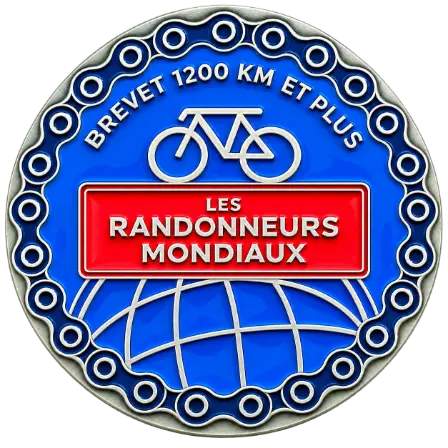
Rides of 1,200 km or more are recognised by Les Randonneurs Mondiaux (LRM). Ireland has its own: Míle Fáilte 1200, with 12,000 m of climbing in 90 hours. Abroad, London–Edinburgh–London was about 1,540 km in 2025, and Italy’s 1001 Miglia is 1,600 km.
- Distance
- 1,200 km or more
- Time limit
- 90 hours for 1,200 km; longer for longer rides
- When
- On a set date, over several days
- Proof
- At every control, staffed or not
- Counts towards
- 4 Provinces only for an event that starts in Ireland.
The exact rules
- Minimum speeds: 13.33 km/h up to 1,299 km, 12 km/h to 1,899 km, 10 km/h to 2,499 km, and 200 km a day beyond that. The maximum is 30 km/h.
- A route climbing more than 11 m per km can be given extra time, typically 5% for each full metre per km, on request to LRM.
- Riders are self-sufficient. Declared support may meet them only at controls or within 5 km of one.
- Any machine powered only by its rider is allowed. Paris-Brest-Paris is not an LRM.
Paris-Brest-Paris
Paris-Brest-Paris is the oldest and biggest of them all: 1,220 km from Rambouillet to Brest and back, every four years. To enter, you ride a series of BRMs in the season before. The next is on 22 to 26 August 2027.
- Distance
- 1,220 km, Rambouillet to Brest and back
- Time limit
- 80, 84 or 90 hours, by start
- When
- Every four years; next 22 to 26 August 2027
- Proof
- Brevet card and chip at every control
- Counts towards
- Not 4 Provinces: it starts in France.
The PBP 2027 guide has the year ahead: qualifying, pre-registration, the new route and the rules.
Sources and further reading
Ready to try one?
Most riders start with a 200. The calendar lists every one this season.